In Hunting Health Care-Associated Infections from the Clinical Microbiology Laboratory: Passive, Active, and Virtual Surveillance (2002) Peterson & Brossette considered the role of data-mining to extract useful knowledge from the huge number of data-points necessary to reporting from laboratory-based microbiology. The builders of a typical first-generation Laboratory Information System (LIS) hand-crafted their own methods of naming microorganisms and linking those to antimicrobial susceptibilities. These methods were adequate for individual patient reports and discrete Infection Control activities within a single facility.
However, when microbiologists heard the calls from Safety & Quality overseers and Public Health practitioners for aggregated data, it was recognised that their LISs were incapable of communicating with other systems. Systems engineers have been trying use HL7 messaging to send reports to public health agencies. But, if HL7 was going to succeed, it would be reasonable to test the methodology on something closer to home – the replacement of legacy systems with modern LISs. Has any public or private laboratory successfully ported all microbiology data from one to the other? If so, has the account of that journey been published for open access?
It’s important to acknowledge when current systems fail to comply with the need to communicate information that has immediate consequences for community health. Such failure seems to have been the case in Pathology lab confirmed legionnaires’ disease a week before Queensland Health was notified
“On investigation we found that the initial result of the first patient wasn’t notified automatically as we usually would,” he said.
What are the standards, then, for storing data in forms that facilitate communication to external systems?
Australian Commission on Safety and Quality in Health Care (ACSQHC) publishes Core Information Components Structured Microbiology Requests and Reports for Healthcare Associated Infections. See Result Observables – Microorganism Classification to be defined (LOINC). See LOINC on Legionella.
The same ACSQHC standard is referred to by DoHA in its submission (#32) to the JETACAR follow-up Inquiry. (3.10)
ACSQHC is developing a standard, hospital-level cumulative antibiogram for local surveillance of antimicrobial resistance. Standardisation of laboratory reporting has been developed as a best practice health information standard for structured microbiology requests and reports.
See, also, AUSTRALIAN PATHOLOGY UNITS AND TERMINOLOGY (APUTS) – requests are mapped to SNOMED, microorganisms in reports to LOINC.
[Below is a previous RCPA org chart – current data is no longer accessible (160529)]
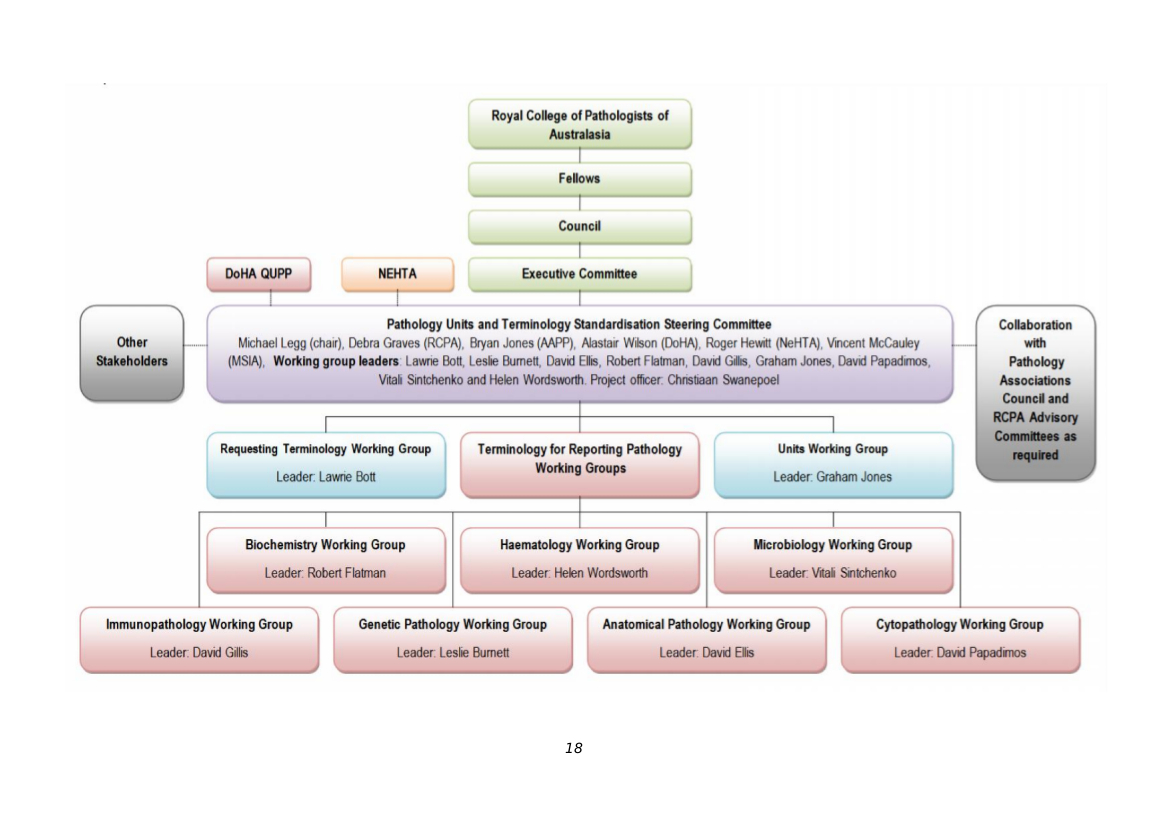
It seems LOINC does NOT refer to an international system of nomenclature for microorganism names. So, how does NEHTA-DoHA plan to track problem microbes, eg., Legionella, Salmonella, MERS-CoV, CRE, etc, in a sustainable, searchable, consistent real-time format? How does the new AMRSC plan to track problematic microbes?
The Antimicrobial Resistance Standing Committee (AMRSC) was established under the Australian Health Protection Principal Committee (AHPPC) of AHMAC on 19 April 2012. The AMRSC is Chaired by Dr Marilyn Cruickshank, Healthcare Associated Infection Program Director at the ACSQHC. Chris Baggoley (Chief Medical Officer) is Chair of AHPPC.
See Attachment 3 (C) to DoHA’s submission (32)

None of that brings us closer to understanding how LISs communicate with each other, even for the highly restricted purposes of public health surveillance.
Is anything known about the methods used by Private pathology corporations to store their microbiology reports? For example –
- Sonic standardises on object-oriented path
[Alan] Lloyd said the lab information system is a high-performance, object-oriented system that provides five times more processing power and uses 10 times less storage.
- Jenny Robson (SNP) on Cumulative Antibiograms Private Pathology Perspective
Is any in-house system (eg, Apollo), SNOMED and/or LOINC going to allow the urgent requirement for clinical microbiology to inform public health?
New methodologies for tracking of communicable diseases, based on sequencing & mapping of microbial genomes, are arising. For example
- NHMRC Grant 457122 Communicable disease informatics: Pattern discovery for public health actions $310,750 over 3 years, start 2008
- Towards bioinformatics assisted infectious disease control Vitali Sintchenko, Blanca Gallego, Grace Chung, Enrico Coiera BMC Bioinformatics 2009, 10(Suppl 2):S10 (5 February 2009)
- At Uni Sydney Dr Grant Hill-Cawthorne is the newly appointed Lecturer in Communicable Disease Epidemiology at Sydney Emerging Infections and Biosecurity (SEIB) Institute, focused on sequencing.
- e-Health preparedness for a pandemic Li, Junhua, Information Systems, Technology & Management, Australian School of Business, UNSW
- Sintchenko V, Gallego B: Laboratory-guided detection of disease outbreaks: three generations of surveillance systems. Arch Pathol Lab Med 2009, 133(6):916-925. PubMed Abstract | Publisher Full Text
- Australia / Singapore to Host Leaders in Emerging Infectious Diseases
- Agency for Science, Technology and Research (A*STAR)
- Software for selecting the most informative sets of genomic loci for multi-target microbial typing Matthew VN O’Sullivan, Vitali Sintchenko, Gwendolyn L Gilbert BMC Bioinformatics 2013, 14:148 (1 May 2013)
- Bacterial Epidemiology, Surveillance & Diagnostics Westmead
- Vitali Sintchenko is head of the Microbiology sub-group in APUTS.
In Diagnosing Emerging and Reemerging Infectious Diseases: The Pivotal Role of the Pathologist. [Archives of Pathology & Laboratory Medicine 135:1, 83-91 Online publication date: 1-Jan-2011. Abstract | Full Text | PDF (155 KB)] authors Olano and Walker describe
… an exponential growth of molecular techniques used for the initial diagnosis of infectious diseases. Molecular tools will also continue to have an impact on disease prognosis and response to therapeutic interventions. Automation, multiplexing, and miniaturization will continue to be driving forces in the development of new instruments.
However, they note caveats.
The incorporation of molecular diagnostics in the clinical microbiology laboratory during the past decade has occurred gradually. In most health care settings, clinicians believe that many molecular tests are already available for clinical use, on the basis of preliminary studies using “home brewed” tests. Most laboratorians have faced this new “crime scene investigation” effect, with its rather unrealistic requests for molecular testing. In fact, FDA-approved tests, although growing at a rapid pace, are available for only a few pathogens. Most likely, in the foreseeable future, molecular testing using expensive, automated systems will not be available at most health care settings owing to financial and staffing issues. Another critical issue is the lack of qualified medical technologists to perform testing, which requires highly skilled personnel. The United States already faces a critical shortage of clinical laboratory scientists.
Whatever the fate of the new, molecular technologies, and the great enthusiasm for more innovations, all putative testing methods require large pools of “clinical material” coming into laboratories so their efficacy can be assessed. We may note, at this point, pathology laboratories in Australia believe that all specimens, even those obtained for genetic analysis, are the property of the collecting agency. There seems to be no moral, let alone legal, obligation to attribute secondary outcomes back to the individuals whose illnesses (and deaths) added to the body of knowledge and advances in diagnosis and treatment. Public (especially “teaching”) hospitals are the best repositories of “clinical material”, no questions asked. Is it different in the private sphere, in that, if people have paid out-of-pocket for care and interventions, may they exert ownership over any part of the downstream activities in laboratories?
There is no doubt that ownership of innovative testing regimens will be vigorously exerted by regional health care networks, the discrete facilities within them and individual clinical research institutions under the hospital banners. An inevitable result of “professional ownership” is that knowledge is not shared until it can be used to advantage, as fodder for the next NHMRC grant, or job in the industry sector or as a meal ticket to another international conference junket. It’s fair to ask
- Are there adverse outcomes under the system of parochial ownership?
- Could the public be better served by more open disclosures?
Answers to (1) may be better addressed at the level of health service management.
- Follow all outcomes of funded research, so that there is accounting for the “duds” as well taking credits for the successes.
- Audit for occasions where new testing methods produced results that could have been harmful to patients.
- Ensure all research funded by NHMRC quotes the Grant number, so compliance with requirements may be tracked at NHMRC.
- Declare all potential Conflicts of Interest when investigating new technologies. Funding for these may come from NHMRC, private foundations, industry (Pharma, diagnostics) and other government soutces (eg, bioterrorism).
Answers to (2) may be best tackled at national level.
- The National Library Trove allows search on outcomes of postgraduate activities, for example, e-Health preparedness for a pandemic turns up as one of seven for theses containing the terms “surveillance, pandemic”.
- NHMRC could be more assiduous to account for outcomes from grants, for example, under http://www.nhmrc.gov.au/national_register_public_health_research/search
Another, more subtle, conflict of interest arises in Outbreak investigation and management.
For example, funding for investigation & prevention of food-borne Salmonella outbreaks would be influenced by public pressure. So, to some degree, more Salmonella infections are “good” for those who researchers who benefit from dispersal of public funds. For example,
- Improving resolution of public health surveillance for human Salmonella enterica serovar Typhimurium infection: 3 years of prospective multiple-locus variable-number tandem-repeat analysis (MLVA) Vitali Sintchenko, Qinning Wang, Peter Howard, Connie WY Ha, Katina Kardamanidis, Jennie Musto, Gwendolyn L Gilbert BMC Infectious Diseases 2012, 12:78 (31 March 2012)
- Salmonella Kentucky: stopping the spread of a new superbug
However, there should be a stronger argument for food-safety education of the public at the raw meats sections of retail food outlets.
—
[added 160529]
From Clinical Microbiology Informatics (Clin Microbiol Rev. 2014 Oct; 27(4): 1025–1047.)
Laboratory reporting of reportable infectious agents to public health agencies or departments is not currently a seamless electronic process. A first step in streamlining the reporting process is to have all the stakeholders share a nomenclature.
- how is data imported from States and agencies, how is it stored?
- latest Report is 2013
— 160606
The real drug problem that could cause a global catastrophe by Peter Martin, see Comments re CRE “50% fatal”…
 Tgk1946's Blog