From Martin Gilbert’s Holocaust Journey (1997).
42 HOLOCAUST JOURNEY
the notorious forced march into Germany of prisoners from camps in Poland, in front of the advancing Russians.’
There are 3,576 war graves here [British military cemetery, Heerstrasse], of which 386 are of unidentified British dead. A series of seven-grave rows running up to the Stone of Remembrance, and on as far as the Cross, each contain a seven-man bomber crew, many in communal graves. As well as the crosses that mark most of the headstones are several with the Star of David on them. Among these is the grave of Sergeant Samuel Cohen, of the Royal Air Force Volunteer Reserve. He was nineteen when he was shot down and killed on 6 January 1944.
9.15 a.m.
Just around the corner from the Commonwealth War Graves cemetery is one of Berlin’s Jewish cemeteries, the Heerstrasse cemetery. A few fifteenth-century Jewish gravestones from an older, abandoned cemetery have been set out here, at the entrance, in a wide expanse of grass. Beyond them are more than a hundred rectangular rose-coloured memorial stones to Berlin Jews who were deported to the East, some of them to the Lodz ghetto (from which they were taken to their deaths at Cheinmo). Both Lodz and Chelmno are on our itinerary. The memorial stones are set starkly on gravel, framed by lush greenery. I read out some of the names: Rudolf Bernstein, Frieda Saphierstein, Regina Katz, Pauline Wolff, Hermann and Johanna Less
In front of the rose-coloured memorial stones, a granite stone with gold-engraved writing marks the spot on which, on 30 September 1984, ashes brought from the crematorium area at Auschwitz were buried. Also in the cemetery, facing the entrance, is the imposing black marble grave of Dr Heinz Gallnski, who led the Jewish community in Berlin from 1945 until his death. He died on 19 July 1992, at the age of seventy-nine.
10.15 a.m.
Having driven along the wooded shore of the Havel (along the Havel Chausee) we come to the small suburban resort of Wannsee, and drive along Am Grossen Wannsee, a street lined with villas. Our destination is Nos. 56-58, the lakeside villa, built in the First World War. There, on 20 January 1942, Reinhard Heydrich, then aged thirty-seven, introduced the ‘Final Solution’ – which had already been decided upon – to the various ministerial bureaucrats who would have to take part in carrying it out. Heydrich’s assistant at the meeting was his contemporary, Adolf Eichmann, just two years his junior.
DAY 3 BERLIN-PRAGUE 43
The meeting was one winch brought together the two centres of power in Nazi Germany, the RSHA (the Reich Security Main Office) represented by Heydrich and five others – plus a female secretary – and the Nazi Party and German government, represented by seven people from different ministries, among them the Ministry of Transport, which was to have such an important part in the deportations.
We reach the entrance to the villa. Seen through the gate, its elegant portal is framed by a hedge and tall dark trees. I hesitate to ring the bell, it seems a place of such enormity. We walk down to the water’s edge, a peaceful, almost idyllic scene. This is Heckshorn Point, a ferry stop, around which – to our left – are a number of popular restaurants. The statue of a lion looks out over the water, a memento of the German defence of this region in medieval times. From the lion, we can look into the Wannsee villa garden. We then return to the entrance of the villa. A gardener, his wheelbarrow next to him, is bending over the fiowerbeds in front of the columned entrance. He is weeding.
10.20 a.m.
Standing in the forecourt, before we enter the villa itself, I give a summary of what was said and decided here, fifty-four years ago. According to the official notes of the Conference, Heydrich began by telling the assembled senior civil servants of his appointment ‘as Plenipotentiary for the Preparation of the Final Solution of the European Jewish Question’. As a result of this appointment it was his aim ‘to achieve clarity in essential matters’. Reichsmarshall Goering, he explained, had asked to see ‘a draft project’ of organisational, factual and material ‘essentials’ in consideration of this ‘final solution’. Such a draft would require the ‘prior joint consultation’ of all the ministries involved, ‘in view of the need for parallel procedure’.
The fourteen people – including the female secretary – who gathered around the table here listened as Heydrich told them that the struggle waged against the Jews ‘so far’ had first involved the expulsion of the Jews ‘from various spheres of life of the German people’. It had been followed by the expulsion of the Jews ‘from the living space of the German people’. Now, as a result of what he called the ‘pertinent prior approval of the Führer’, the ‘evacuation of the Jews to the East’ had emerged ‘in place of emigration’ as a ‘further possible solution’. But both emigration and evacuation were, he explained, to be considered ‘merely as a measure of expediency’. From them, experience could be gained winch would be of importance ‘in view of the approaching final solution of the Jewish question’.
44 HOLOCAUST JOURNEY
Heydrich then explained that this ‘final solution’ concerned, not only those Jews who were already under German rule, but ‘some eleven million Jews’ throughout Europe. He then gave the meeting; including -the Gestapo chief, Heinrich Miller, a list of the numbers involved.¹
The figures presented by Heydrich included 34,000 for Lithuania. The other 200,000 Jews of pre-war Lithuania had already been murdered – between July and November 1941. The largest number of Jews listed by Heydrich were those in the Ukraine: his figure was 2,994,684. The second largest was for the General Government (German-administered central Poland): 2,284,000. The third largest was for Germany’s ally, Hungary: 742,800, a figure which included the Jews in Ruthenia, the eastern part of Czechoslovakia which had been annexed by Hungary at the beginning of the war.²
The fourth-highest figure was for unoccupied France: 700,000. This figure included the Sephardi Jews in France’s North African possessions. Next largest in the list was White Russia, with 446,484 Jews listed, followed by the 400,000 Jews of the Bialystok region.
Estonia was listed as ‘without Jews’. This was true. Of Estonia’s 2,000 Jews in June 1941, half had fled to safety inside the Soviet Union. The remaining half had already been murdered in the six months since the German occupation of the Baltic.
Listening inside the Wannsee villa to this statistical survey of the numbers of Jews who were marked out for death were a dozen German civil servants. Eight of them had university doctorates. They had come to the meeting from their offices in the Ministry for the Occupied Eastern Territories, the Ministry of the Interior, the Justice Mipi4ry, the Foreign Office, the Chancellery, the SS-Race and Resettlement Office, and – having made the journey from Cracow by train – from the General Government. Also present at Wannsee that January morning was the Plenipotentiary for the Four Year Plan, responsible for disposing of Jewish property, and representing six more ministries.
Heydrich asked all those present, and their ministries, to co-operate ‘in the implementation of the solution’. He told them: ‘In the course of
—
¹These numbers Included 330,000 Jews in as yet unconquered Britain. All the Jews In the neutral countries of Europe were also listed: 55,000 in European Turkey, 18,000 in Switzerland. 10,000 In Spain, 8,000 in Sweden, 4,000 in the Irish Republic and 3,000 In Portugal.
²As well as Hungary, Jews living in five other countries which were allied to Germany were also fisted: 342,000 In Roumania. 88,000 In Slovakia, 58,000 in Italy (including Sardinia), 40,000 In Croatia and 2,300 in Finland. The smallest number given was the 200 Jews of Italian-occupied Albania.
—
DAY 3 BERLIN-PRAGUE 45
the final solution, the Jews should be brought under appropriate direction in a suitable manner to the East for labour utilisation. Separated by sex, the Jews capable of work will be led into these areas in large labour columns to build roads, whereby doubtless a large part will fall away through natural reduction. The inevitable final remainder which doubtless constitutes the toughest element will have to be dealt with appropriately, since it represents a natural selection which upon liberation is to be regarded as a germ cell of a new Jewish development.
‘In the course of the practical implementation of the final solution,’ Heydrich said, ‘Europe will be combed from West to East. If only because of the apartment shortage and other socio-political necessities, the Reich area – including the Protectorate of Bohemia and Moravia – will have to be placed ahead of the line. For the moment, the evacuated Jews will be brought bit by bit to so-called transit ghettos from where they will be transported farther to the east.’
The many extreme euphemisms in Heydrich’s account were the rsu1t of several rewritings of the protocol of the meeting.
It was intended, according to the statistics presented to the Wannsee Conference, that a total of 11,000,000 European Jews should ‘fall away’ (in the language of the conference), including those in the neutral and unconquered countries.
There followed a discussion of what were seen as the various problems involved. ‘In Slovakia and Croatia,’ Heydrich told them, ‘the situation is no longer all that difficult, since the essential key questions there have already been resolved.’ As for Hungary, ‘it will be necessary before long,’ he said, ‘to impose upon the Hungarian government an adviser on Jewish questions.’ Roumania posed a problem, as ‘even today a Jew in Roumania can buy for cash appropriate documents officially certifying him in a foreign nationality’. Speaking of the occupied and unoccupied zones of France, however, Heydrich commented that there ‘the seizure of the Jews for evacuation should in all probability proceed without major difficulty’.
By far the largest number of Jews lived in the General Government (Generalgouvernement) – the main expanse of German-occupied Poland. The attitude of its administration was crucial to any ‘final solution’. Dr Josef Bühler, the representative of the General Government – who was accompanied by the Commanding Officer of the Security Police in the General Government, SS StandartenfUhrer (lieutenant-Colonel) Dr Karl Schoegarten – stated that his administration ‘would welcome the start of the final solution in its territory, since the transport problem was no overriding factor there and the
46 HOLOCAUST JOURNEY
course of the action would not be hindered by considerations of work utilisation’. Bühler added: ‘Jews should be removed from the domain of the General Government as fast as possible, because it is precisely here that the Jew constitutes a substantial danger as carrier of epidemics and also because his continued black market activities create constant disorder in the economic structure of the country. Moreover, the majority of the two and a half million Jews involved were not capable of work.’
Dr Bühler had, he said, ‘only one favour to ask’, and that was ‘that the Jewish question in this territory be solved as rapidly as possible’.
The meeting was drawing to its end. ‘Finally,’ the official notes recorded, ‘there was a discussion of the various types of solution possibilities.’ What these ‘possibilities’ were, the notes of the Conference do not record. At his trial in Jerusalem in 1960, Eichmann told the court: ‘I remember that at the end of this Wannsee Conference Heydrich, Muller and my humble self settled down comfortably by the fireplace, and that then for the first time I saw Heydrich smoke a cigar or a cigarette, and I was thinking: today Heydrich is smoking, something I have not seen before. And he drinks cognac – since I had not seen Heydrich take any alcoholic drink in years. After this Wannsee Conference we were sitting together peacefully, and not in order to talk shop, but in order to relax after the long hours of strain.’
What Eichmann called the ‘long hours of strain’ were over. It had all taken less than a day. Heydrich was certain that the time was right for the deportation and destruction of millions of people. The technical services such as the railways, the bureaucracy and the diplomats would work in harmony, towards a single aim. Local populations would be cajoled or coerced into passivity. Many would even co-operate, and some would co-operate gladly: that had been made clear already.
10.25 a.m.
The time has come for us to enter the villa. It is now a memorial, consisting of a museum and an educational centre. It has an archive and a library, and a department which organises study days and seminars. Up to now, 210,000 visitors – groups and individuals – have found their way, like us, to its door.
We walk up the path, some hesitating, and then enter. As we walk round the villa, it quickly becomes clear that the presentation is most impressive. The story of the Holocaust is set out in the downstairs rooms, with clear explanations and excellent photographs and facsimile documents. There are fourteen rooms with exhibits, and a fifteenth
DAY 3 BERLIN -PRAGUE 47
room with the history of the villa before 1939 and alter 1945. We walk through the rooms in their historical sequence: the National Socialist dictatorship in Germany, the pre-war period, the war against Poland (1939), the ghettos, mass executions (in German-occupied Russia after the German invasion of the Soviet Union in June 1941), the Wannsee Conference itself, deportations, the ‘Hall of the Countries’, death camps and transit camps, Auschwitz (a room on its own), concentration camps, the Warsaw ghetto uprising, ‘The End’, and liberation.
In what is believed to have been the actual room in which the Wannsee Conference took place, with its tall picture windows looking out over the patio and lawn down to the lake, there is a stillness. We walk into the room, through it, round it and then out of it, as if it must not be disturbed. It is as if the voices of those who spoke here, and the heads of those who nodded their agreement here, must not be alerted to our presence. One feels a palpable sense of the presence of evil. Despite the bright sunshine outside, and the large windows, the room seems eerily dark. Along one wall are the photographs of all those who were at the meeting, and descriptions of who they were: most of them professional civil servants of the highest degree of bureaucratic competence.
In an adjoining room are various artefacts, including a roll of yellow cloth on which innumerable yellow stars with the word ‘Jude’ on them have been printed, ready to be cut out and sewn on to Jewish coats and jackets. The lines for cutting around the stars have been marked on the cloth. Also on display is an original telegram, dated 30 July 1943, about the despatch of a consignment of Zyklon-B poison gas to Auschwitz.
10.29 a.m.
I go up in the lift – which was already here in those days, and very evocative it is too, with its plush furnishings – to see the founding director, Gerhard Schoenberner. His office is on the third floor (the second floor houses the library and seminar rooms), and overlooks the lake. He notes that there are three such memorials in Berlin: the one in the former Bendlerstrasse – where many of the conspirators against Hitler were killed – the one at the former Gestapo headquarters, and this. ‘Three attempts to deal with a chapter of contemporary history’ is how he expresses it.
Schoenberner explains that immediately after the war the villa was first used by the Red Army. Shortly afterwards it was used as a United
48 HOLOCAUST JOURNEY
States Army officers’ club. Then it became the Centre for Political Education of the Social Democratic Party of Berlin. They rented it from the city. ‘I first came here as a schoolboy in short trousers,’ says Schoenberner with a smile. ‘I was a very young boy, just fifteen years old. We came here to listen to lectures on democracy. There were just ten to twelve of us. I remember one of the lectures was on the model of Scandinavian socialism. Nobody had heard of the lecturer. It was Willy Brandt.’ Brandt was an anti-Nazi who had fled from Germany in 1933, living first in Norway and then in Sweden. He was German Chancellor from 1969 to 1974.
Schoenberner himself came from an anti-Nazi family. In 1957 (two years before I did the same) he went on a student exchange to Poland. He was then head of the editorial board of the West German socialist students’ monthly magazine. One result of his visit was a documentary volume, The Yellow Star, published in English in 1960. It was one of the very first books that I read on this subject: I still have my original, now somewhat dog-eared copy.
A second result of Schoenberner’s Polish visit was the preparation – ‘with enormous difficulties’, he recalls – of an exhibition entitled ‘The Past is Warning’. It was shown in the West Berlin Congress Hall, and elsewhere in West Germany. ‘I remember how I went to the United States Press Office to ask for technical assistance. But the man in charge said to me: “This is not in the interests of American policy.” The main goal then was to win over Germany as a military ally against the Soviet Union. Then, in 1965 Joseph Wulf, a German Jewish historian, and a survivor of Auschwitz, who was a pioneer in documenting Nazi crimes in Germany, together with a couple of friends and colleagues of whom I was one, made a proposal to transform the villa into a museum, to give it a new function, relating to its history. We got prominent backing in Germany and abroad. The list of names signing our demands read like an excerpt from Who’s Who. But then nobody in politics understood the necessity. Nobody was interested; the political priorities were different. It took almost a quarter of a century before the City of Berlin and the Bonn Government decided to agree, and to finance the whole undertaking.’
Schoenberner has devoted considerable energy and thought to making this museum work. ‘The house opened on the fiftieth anniversary of the meeting – in January 1992. 1 started preparing several years before. I had to write the concept for the house, and have the building renovated, and last but not least I had to prepare the permanent exhibit. Thank Heaven I was familiar not only with the theme
DAY 3 BERLIN-PRAGUE 49
but with the international archives as well. In the last decade we had a children’s recreation home here. Everything had to be regenerated – to make a little bit visible the historical focus of the house.’
As he began his work, Schoenberner was concerned about how to tell the story of the Holocaust in fifteen rooms, not designed for exhibitions, some of them rather small. ‘I had the ambition,’ he tells me, ‘to avoid the typical mistakes, which had angered me so many times as a visitor to other exhibitions of that kind. I had seen so many textual explanations on exhibits, very often much too long, placed much too low. In many museum exhibits you have to be as low as a basset hound to see them. I was also concerned about the legibility of words in the textual descriptions where a word is broken into two lines. I am very interested in these aspects as well, it is so important that the exhibits should be clear and the text clear.
‘I am interested in transmitting something. You have to think how to do it. This house was never built for exhibitions. I knew this building since the end of the war. It is an unbearable combination – this late bourgeois interior and the terrible story of what happened in these rooms. But once we are here, in this house, we have to show the visitor where we are, and what happened here at the beginning of 1942. 1 was concerned with what materials to use. The designer came with glass. I said, “My God, this is much too elegant. It might be suited to a Gold from Peru exhibit, but not for our purpose.” So we decided to use frosted glass.’
Schoenberner has certainly succeeded. Suzanne Bardgett, from the Imperial War Museum, who is travelling with us, asks him about security. ‘Up till now,’ he says, ‘nothing has happened. Not one little word sprayed on the walls. But you have to be prepared. You don’t need a mass neo-Nazi movement – two fanatics are enough. Recently some skinheads came up here with the school classes. But they quickly understood that this was not the proper background for their parades, and they disappeared.’
10.50 a.m.
We leave the Wannsee villa, our visit curtailed as a result of the morning bus delay. This also means that we cannot go to the Grunewald railway station, to see the place from which Berlin Jews were deported, and to read the plaque there. It was unveiled on 3 April 1987. The first deportation took place from here on 18 October 1941, to the Lodz ghetto.
—
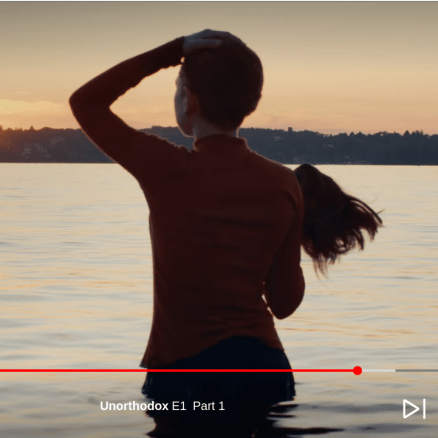
(220812) see ‘Unorthodox’ Ep1 Esty wades into Wannsee, takes off her wig.
https://tgk1946.com/wp-content/uploads/2022/08/wannseeswim.png?resize=438%2C438
 Tgk1946's Blog