From The Shortest History of Germany (James Hawes, 2018) p110-123
No one knew that Bismarck and the Prussian General Staff under Helmuth von Moltke had been planning this very war for several years. Bismarck carefully secured Russian neutrality, so that no forces needed to be left in the east; Moltke used the railway system to get troops to the front more swiftly than anyone thought possible; and in Krupp’s new rifled-steel, breach-loading artillery (forged in the industrial lands so fatefully given to Prussia by Britain in 1815), the Prussians possessed a step-change in military technology. Out-planned, outnumbered in every battle and catastrophically outgunned, the French never stood a chance.
To contemporaries, it seemed astounding. A wave of nationalist fever swept Germany as the centuries-old shadow of French hegemony was blasted away. Paris itself was besieged and in their euphoria or megalomania, the Prussian army insisted, against Bismarck’s initial resistance, that it was militarily necessary to take Alsace and Lorraine. These had been French for several generations and (judging by their voting habits for the next twenty years) the vast majority of the people would have been content to stay that way, even though they mostly spoke dialects of German. The annexation was to prove an immobile block to Franco-German relations.
The south German kingdoms, whose contingents had found themselves part of this amazing victory, now began to negotiate entrance to the North German Confederation, though with clauses to guard their own autonomy. Suddenly, on 10 December 1870, the North German Confederation declared that it was now an Empire, and that the King of Prussia was its Emperor. Bismarck made it clear to the south-west that backing out now was not an option.
On the morning of 18 January 1871, in the Hall of Mirrors at Versailles, Bismarck and Wilhelm I appeared in high ill-humour, having been locked all night in a bitter, table-thumping argument about whether Wilhelm would be called German Emperor or Emperor of Germany. The Grand Duke of Baden solved the problem by simply crying out long live the Emperor Wilhelm. In strictly legal terms, the day had no more significance than the day the Berlin Wall fell, but history doesn’t work in strictly legal terms. The Second German Empire was now a fact.
The south-west of Germany, which had been a constituent part of Western Europe since 100 AD, was now completely in the hands of a power from beyond the Elbe which had only existed for three and a half centuries. The centre of gravity in Europe had shifted dramatically eastwards. Disraeli immediately saw that this was a greater political event than the French revolution of last century.
The New Paradigm
The new German Empire was founded in a heady atmosphere of victory, and its economy, fed by trainloads of free gold bullion from occupied France, boomed immediately. From the start, it was clearly a strange animal.
It didn’t include over eight million people who had, until 1871, always thought of themselves as German — in Austria, Bohemia and Moravia — but it did contain three million Poles, as well as large, recently-conquered Danish and French minorities in Schleswig-Holstein and Alsace-Lorraine, who had no intention of becoming Germans. No Germany, even of the imagination, had ever looked like this. For many years, foreign observers regularly called it Prussia-Germany or even simply Prussia.
This empire seemed perfectly designed to be impossible or anyone but Bismarck to run. As well as the imperial Reichstag in Berlin, every state also had its own Landtag But since Prussia was now so vast, the Prussian Landtag (also in Berlin) actually ran day-to-day business in two-thirds of the entire Empire. It had a unique three-tiered electoral system where the weight of a citizen’s vote depended on how much tax he paid. In rural constituencies of East Elbia, which typically had a couple of big estates, almost no middle class, and many obedient peasants, Junker landowners virtually chose MPs for their very own Konservative Partei.
The Reichstag, just down the road, was elected on universal male suffrage. But its MPs could not get rid of the chancellor; only the emperor could do that. So long as Bismarck retained King Wilhelm’s confidence, all MPs could do was refuse his bills or budgets, forcing new elections. If that happened, Bismarck himself frequently hinted, he might unleash his scar-faced Junker samurai and their savagely-drilled farm-boys. When the debate is over and the vote is about to be taken… a door opens and in strides Prince Bismarck, in cuirassier uniform with huge jack-boots and an enormous sword which he clatters along the floor. The House is crushed and acts as though these military statesmen had behind them a regiment of the line ready to enforce obedience at the point of a bayonet. Henry Vizetelly, Berlin under the New Empire, London, 1878 Bismarck was able to keep up democratic appearances because there was a big party in the Reichstag that was in practice loyal to him alone. This party was the National Liberals, whose power-base was Prussia and the smaller Protestant states. They are central to German political history after 1871.
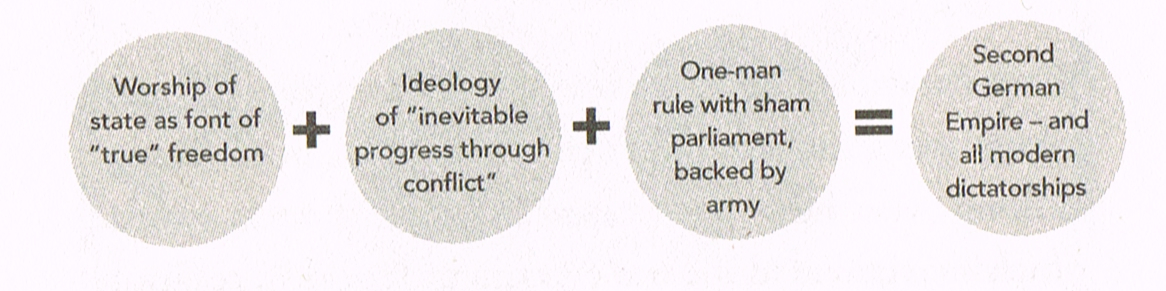
The National Liberals had split away from the old liberals after the war of 1866 and developed their own, unique spin on Victorian liberal thought. They believed in Progress and Freedom, of course — but in a rather new way. To them, Progress didn’t mean delivering more, messy, individualistic, so-called freedom. Mankind’s real Freedom (as Hegel had claimed) lay in belonging to a smoothly functioning state — like the new Prussian-German Empire. It wasn’t perfect yet, of course, but success in war and business was the Darwinian proof that it was on the right lines. Therefore (so went National Liberal logic) Bismarck should be supported to the hilt. In this alliance between Bismarck’s new Empire and the ideology of Progress-through-Conflict we first see the great pillars of every full-blown modern dictatorship, in embryonic form:
The God of Progress Fails
Bismarck almost immediately declared war on the social and political influence of the Catholic Church in what was known as the Cultural Struggle (Kulturkampf). Schools were to be taken out of Church control, civil marriages allowed and priests forbidden from engaging in anything that could be termed political opposition.
Foreign observers were baffled: gratuitously picking a fight with just-annexed southern Germany and the Polish minority in Prussia seemed a strange way to unite the new Empire. But Bismarck didn’t want unification. He wanted prussianization ~ and his vital allies, the National Liberals, wanted Progress. Fighting the Catholic Church was the one sure way to join these political dots.
Soon, however, this strange new imperial project was in a complete shambles. The almighty boom had been built on robbed French gold; as soon as it dried up an almighty crash followed. It took 40 years for the Berlin stock exchange to get back to the high of late 1872. The experience was seared into the German language as the Age of the Founders (Griinderjahre) — meaning not the founders of the new empire, but founders of dubious, speculative companies. While the economy tanked, the Catholic population and the Church held out against the Kulturkampf. State repression grew so harsh that even the Prussian Conservatives refused to back it. In the end, all Bismarck achieved was to succour the Catholics’ very own new political vehicle, the Centre Party, which became for over two decades the largest single party in the Reichstag. Meanwhile the German socialists united in 1875 under a Marxian banner and their rival take on Progress — one which ended in the millennium of World Revolution – started to score electoral successes.
Bismarck considered another war to shore up his rule. In 1875 he used his tame press to hint that a new strike on France might be in sight. The War in Sight Crisis led to the supposedly impossible: Britain and Russia made moves to ally with France against Prussia-Germany. Bismarck had to beat a hasty retreat, furiously claiming that she Englishwoman — the Crown Princess ~ had betrayed him to Queen Victoria.
Nothing was going right for the new Prussia-~Germany. Then it got worse.
Bismarck Dooms Germany
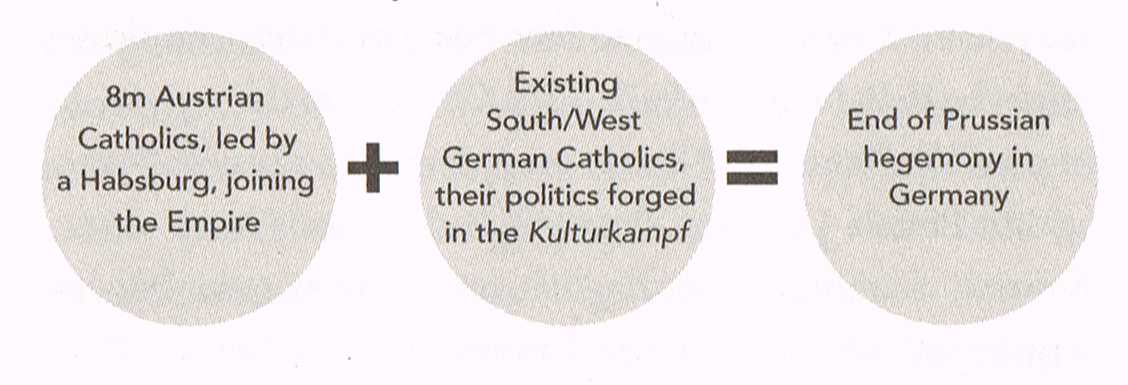
From 1876, a wave of Pan-Slav nationalism swept south-eastern Europe, which was still ruled by the Turkish Ottoman Empire. Russia successfully attacked the Turks in 1877 and now posed as the protector of all Slavs everywhere. This was potentially fatal to the Austro-Hungarian Habsburg Empire. It had come perilously close to collapse after its defeat by Prussia in 1866. Now, if its Poles, Slovenes, Serbs, Croats and Czechs rose up, backed by Russia, it would be finished. The ruling German minority would surely want to flee into the new German Empire, and all Germany would surely demand they be let in. To Bismarck, this would be disaster. He had never wanted a united Germany, just a Prussian Germany. If eight million more Catholic Germans were received into the Empire – if Vienna joined Munich and Stuttgart as counterweights to Berlin, and with a Habsburg king on board to boot — Prussia’s game would be up.
For Prussia to keep ruling over Germany, the multi-national Austro-Hungarian Empire had to be kept afloat at all costs. As Bismarck admitted to Disraeli on 17 June 1878, he was bound hand and foot to Austria.So Bismarck made a U-turn that astonished the world: he called off the Kulturkampf, broke with the liberals, abandoned Free Trade and, in October 1879, signed an anti-Russian defensive alliance with his oldest enemy, arch-Catholic Austria.
The Dual Alliance of 1879 was a terrible deal for Germany. There was nothing in the diplomatic air that might make Russia attack Germany, whereas the frictions between Russia and Austria-Hungary in the Balkans were very real. Now, if the Habsburgs could just goad Russia into drawing first, they’d have the whole might of a united Germany to back them in their adventures beyond the Danube.
In 1815 and 1850, Vienna had wanted to have its cake and eat it, by remaining a vast, only part-German dynastic empire, yet also determining all-German policy. In 1879, it got exactly that. For the side that had been whipped by Prussia in 1866, it was an amazing comeback. No sane German statesman would ever have agreed to it.
Bismarck wasn’t insane. But he wasn’t really German, either. He was Prussian. And to safeguard Prussian rule over Germany, he forged the military union with Austria in the full knowledge that some damn stupid thing in the Balkans — the words are his own — could condemn all Germany to war with Russia. The old, west-facing kingdoms and duchies of Germany now faced being dragged by Prussia into a Balkan conflict between the eastern Germans and the Slavs that had nothing to do with them.
Darkness Visible
Bismarck’s change of course in 1879 was so drastic that historians talk about the second foundation of the Empire. It left one particular group in Germany floundering: people who self-defined as Protestant Germans. They were mostly in the north and east, but had local power-bases elsewhere, in lands whose rulers had backed Luther, or in towns developed later as Prussian administrative bastions. The state-sponsored Kulturkampf against the Catholics had radicalised them — but in 1879 they found themselves dumped by Bismarck in favour of deals with Catholics and conservatives. These embittered acolytes of Progress now made Being Protestant German into a new ersatz religion of alien-free German-ness (Deutschtum). Anti-Catholicism was second nature to them, but the fatal spine of the movement was a brand new kind of anti-semitism.
The great proclaimer of this was the official Prussian State Historian, Heinrich von Treitschke, guru of the National Liberals, whose prestige was vast and whose drum-like shriek, as one American observer called it, frequently enthralled the Reichstag. Treitschke’s 1879 article Our Prospects (Unsere Aussichten), better known as its shorter 1880 form A Word about Our Jews, is the founding document of modern political anti-semitism. From now on, hating the Jews wasn’t just about hating the Jews; it was a fully-fledged ideology, unlike any other form of racism.
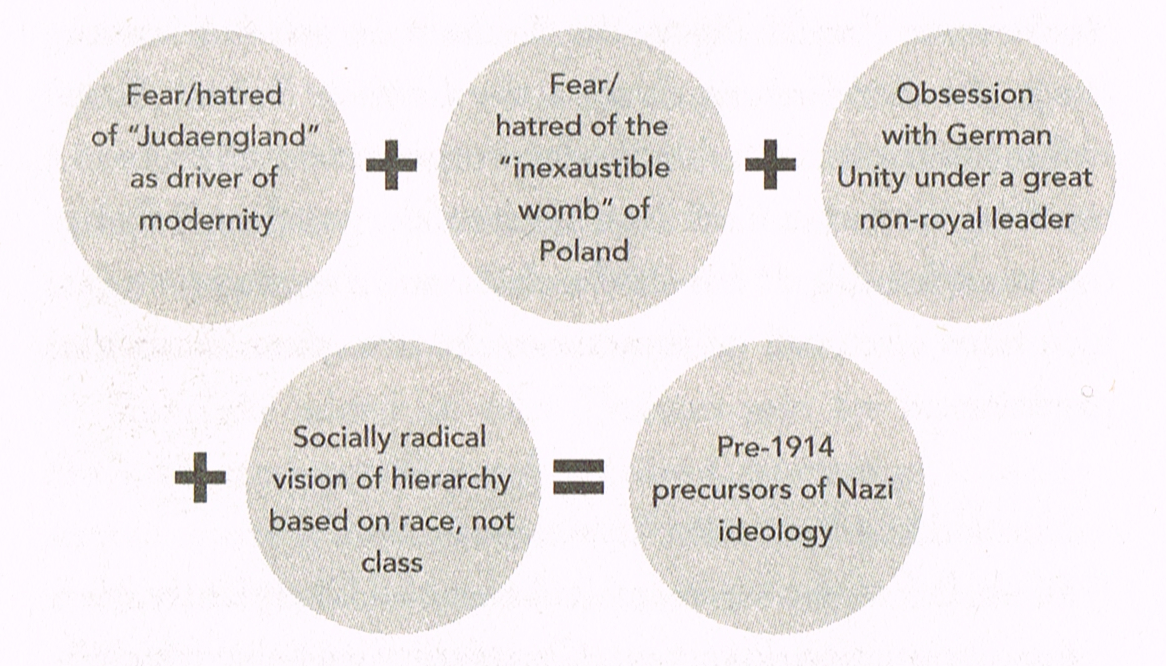
To Treitschke, the Jews were our misfortune. They had a deep, mysterious relationship with the Englanders (about whom he had long raged). Like the English, they were personally degenerate and cowardly, with the mentality of shopkeepers rather than heroes, yet somehow – in contradiction of all true Progress! — they ran the world. Ruthless, globalising, culture-less, finance-driven Modernity was the Anglo-Jewish master-plan. More healthy but simpler nations, like the Germans, were putty in their hands. Every anti-semite since Treitschke has signed up to this conspiracy theory: Kaiser Wilhelm II talked of Judaengland just as modern anti-semites do of Jew York.
Treitchske added an extra Prussian spin for his readers. From the inexhaustible womb of Poland, he claimed, came an annual swarm of ambitious young Jewish trouser-peddlers whose children and grandchildren will rule the press and stock-exchanges of Germany. He thus neatly managed to link fear of allegedly Jewish/Anglo-Saxon modernity with the ancient Prussian colonial fear and loathing of Poland. The Jews were painted as internationalist, money-bagged internal Englanders and penniless, fast-breeding Polish immigrants, rolled into one.
To radical Protestants, the Jews henceforth joined in dark union with the Catholic Church as foreign bodies within Prussian-German-ness. The cry went up: Without the Jews, without Rome, we shall build the cathedral of Germania (Ohne Juda, ohne Rom, bauen wir Germanias Dom). Nor would there be anywhere for the old Junker aristocracy in this new, Germanic cathedral. The rabid young librarian Dr Otto Béckel won his Reichstag seat from the Junkers’ own Conservative Party in 1887 with the catchy slogan Jews, Junkers and Priests all belong in the same pot (Jude, Junker und Pfaffen gehoren in einen Topf ). His allies compiled a notorious handbook called the Semi-Gotha, which listed all the nobility allegedly tainted by Jewish blood.
For this new anti-semitism was a socially radical movement. It claimed that what true German-ness needed was a new aristocracy of race, not of family. Leaders of the Anti-semitic People’s Party, the German Social Anti-semitic Party, the Pan-German League, the German Reform Party and suchlike often gave themselves forged titles and by 1908, one false aristocrat, Lanz “von” Liebenfels, was already flying the swastika flag at his castle. National Protestantism (as historians often call it) sometimes slid into pure Germanic paganism.
The National-Protestant Vision, 1902
The belief of the Germanic tribes is the Christianity of the Reformation. Protestant Christianity is a belief which does not crush German nature, that nature so full of power and resistance, but rather unfolds it… Protestantism is the rock on which the culture of the German tribes, of the Germanic race, is built. Protestantism is the fundament of its political power, of its moral virtues, of its dauntless, victorious science. C. Werkshagen, Der Protestantismus am Ende des XIX Jahrhundert in Wort und Bild, Berlin 1902.
In 1893, candidates who made anti-semitism their main platform (half of them actually called themselves Anti-semites on the ballot-slips) won sixteen Reichstag seats, all of them in rural, Protestant Prussia, Saxony and Hesse. What followed is a lesson to any country with a noisy, radical minority.
Those sixteen seats on their own meant little. But the Conservative Party, the political wing of Prussian Junkerdom, panicked at any inroad into its power-base. In 1892 the Tivoli Programme made it official Conservative policy to oppose the often obtrusive and corrosive Jewish influence on our national life. Open anti-semitism was now socially respectable at the highest levels.
Bismarck Unleashes Anglophobia
Just as this movement was being born, Bismarck himself was hoping that a British Jew might save the Prussian Empire from war with Russia.
He was convinced that in Benjamin Disraeli, Britain at last had a real leader again —- meaning, one who would stand up to Russia. A grand vision hovered before Bismarck: a global German-British alliance. And the British Conservatives saw the point.It was a marriage proposal born out of geopolitical logic. Russia threatened Britain in India; it threatened Austria in the Balkans; it threatened Prussia in the Baltic. Together, the three of them could face it down anywhere on Earth.
Then, in the general election of April 1880, the British shocked everyone (including Queen Victoria) by throwing Disraeli out and handing power to the liberal William Gladstone, who loathed Bismarck and vice-versa.
Bismarck’s plans lay in ruins. The very day the British election results became known, he sent his envoys racing to St Petersburg in a frantic damage-limitation exercise. He now switched to a deliberate policy of anglophobic colonialism. This would placate at least some of the National Liberals, who’d long demanded colonies. Bismarck had always said no to them in the past for fear of entanglements that might upset his European chess-games. Now he said yes. Because now, distant entanglements with the Englanders were just what he wanted. They would make life hard at election- time for anyone in Germany who sounded remotely pro-British — such as the Crown Prince and the new, united liberal opposition. Bismarck explained this tactic himself to the Tsar, who was amazed at such political cunning. So he unleashed the German colonial movement and made sure that its first colonies, in Africa and the South Pacific, were in areas the British regarded as their own.
There was another angle. Bismarck hoped that France and Russia might be persuaded to drop their vengeful plans for Alsace-Lorraine and the Balkans to join a new geopolitical drive at Britain’s expense.
Bismarck indeed triumphed at the Reichstag elections of 1884. But nothing could break the logic that was bringing France and Russia closer: in 1885-6 the French refocussed on revanche (revenge) against Germany, while Russian policy turned again to the Balkans, threatening Austria. Meanwhile, the price of Bismarck’s anglophobic campaign was high. The Royal Navy and the US Navy spontaneously made common cause against German expansion in the South Pacific: on Samoa, in 1889, it came very close to a shooting war. This was the seed of the special relationship between the US and the UK.
There was no natural connection at all between Tsarist Russia’s ambitions in the Balkans and republican France’s wish to be revenged for 1870. But because Bismarck had welded himself to Austria-Hungary in the Dual Alliance of 1879, France and Russia began to have a very obvious common interest.By New Year’s Day 1887, the constellation that would result in ww1 was already visible. Waldersee, Moltke’s heir apparent as head of the Prussian army, wrote in his diary that war with France was now inevitable and that it might become a World War (Weltkrieg). He began plotting a two-front war against both France and Russia.
Bismarck, meanwhile, plotted desperately to avoid it. He knew that the Prussian victories of 1864 (Denmark), 1866 (Austria) and 1870 (France) had depended on his diplomacy. For the sake of Prussian rule over Germany, he couldn’t break the Austrian alliance of 1879, so he tried to finesse it in his secret Re-Insurance Treaty with Russia (1887), which promised Germany would stay neutral if Austria should attack Russia. He knew perfectly well this would never happen: the treaty was just an attempt to muddy the waters in case of war and keep Russia off our necks for six to eight weeks (as Bismarck’s son, the Foreign Secretary, put it) until France was beaten.
 Tgk1946's Blog